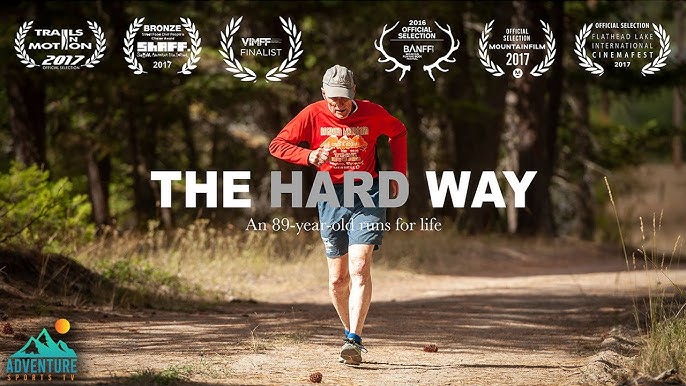
The Hard Way: Why 89-Year-Old Bob Hayes Refuses to Stop Running
30 races a year. Tough mountain trails. Running in logging boots just to see if it’s possible.
For Bob Hayes, age isn’t a boundary or a number to complain about. It’s simply a frame of time. Born in Vermont in 1926, Bob didn’t lace up his first pair of running shoes until 1986, when he was already 60 years old. His kids badgered him to start, and when he finally tried a local 5K, he was instantly hooked.
Now, at 89 years old, he is still finding meaning between a start line and a finish line.
But distance alone doesn’t tell his story.
Running Through the Darkest Valley
Running was never just a solo pursuit for Bob. For years, his wife ran alongside him. When she was diagnosed with Alzheimer’s, Bob didn’t leave her behind; he became her running partner and her caretaker.
During their final races together, as her condition worsened, he would hold her hand on the technical mountain descents. She would fall, bleeding and bruised, but they kept moving forward together until she no longer could.
When the disease finally confined her to the house, Bob took care of her completely on his own — feeding her, bathing her, and sleeping on the floor right beside her bed to check on her through the night. In June, she quietly passed away.
In the heavy silence that followed, the routine of moving forward became a lifeline.
When the Momentum Fades
Bob’s life has always been defined by momentum. When he isn’t training for rugged ultramarathons like the Bighorn 50K, he is out on his Montana ranch cutting firewood, fixing fences, and working on the barn. “You kind of feel useful with a routine like that,” Bob says.
But the mountains have a way of breaking everyone down, regardless of experience.
At a recent edition of the Bighorn 50K, a race he has frequented for two decades, Bob faced a setback that shook him to the core. Just four miles into the race, his body completely shut down. For the first time, he couldn’t run. He felt entirely exhausted and missed the strict time cutoff.
For an athlete who feels like Superman to his peers, failing to finish was devastating. He didn’t run for nearly three weeks, gripped by the quiet, terrifying fear that his mountain chapter might finally be closing.
The Next One
But a true runner knows that a DNF doesn’t erase your identity. It refines it.
When asked what his favorite run is, Bob’s answer is always immediate: “The next one.”
Weeks after his defeat, Bob signed up for the grueling John Colter race in Three Forks, Montana. Driving to the event, playing his harmonica to stay awake behind the wheel, he accepted the reality of his journey. “I don’t think I can do it,” he joked before the race. “But I don’t want to quit. I ought to be good for a couple more years.”
On the trail, stripping away all the noise and distractions of the world, Bob found his rhythm again. Trudging up steep hills alongside running partners who are decades younger, he crossed the finish line to claim his award.
“I was the oldest guy and the fastest guy in the 80s,” Bob laughs. “And I was the only guy in the 80s, so I got first, second, and last in my age group.”
Why We Keep Going
People are naturally drawn to Bob Hayes because he embodies a rare, head-over-heels passion that completely defies the boundaries of aging. He doesn’t talk about getting older. He doesn’t look for the easy paths.
“I’m at the point where I don’t need to do the easy things,” Bob notes. “I need to do the hard things to keep me in shape.”
For Bob, running isn’t a hobby anymore. It’s how he keeps illness, grief, and death at bay. It’s a stubborn, beautiful dedication to the quality of his life.
We keep going because that’s where we feel most alive. And for Bob, as long as there is a next race on the calendar, there is a reason to take life year by year, step by step, the hard way.